🇨🇦 Canadian Headquarters · GMP Manufacturing Network Across 5 Countries +1 (437) 595-0172  |  [email protected]
0%

Choosing a whey supplier is not a paperwork exercise. It affects what ends up in every scoop: the protein level, flavor consistency, and whether each batch matches its specification. Grand View Research’s 2023 whey protein market report estimated the global market at about US$6.3 billion, with continued growth projected through 2030. That expansion brings more options—and makes careful supplier checks more important.

A useful research takeaway from protein-metabolism expert Dr. Stuart Phillips is: “Protein quality matters, not just total grams.” This is a paraphrase of his broader research, not a verbatim quotation. For buyers, that principle means looking beyond a bold number on a label. Ask how the manufacturer verifies protein content, manages raw-material sourcing, and tests finished batches. Request recent certificates of analysis, review audit documentation, and confirm that samples match the product specification. A powder may look fine in a sample jar. Batch records tell a deeper story.

This guide explains how to assess Whey Protein Powder Manufacturing partners, from production controls to communication and traceability. It also draws on the kind of practical questions experienced buyers ask during supplier reviews. No checklist can remove every uncertainty. But clear records, testable claims, and a willingness to answer detailed questions are good signs. The small details matter.
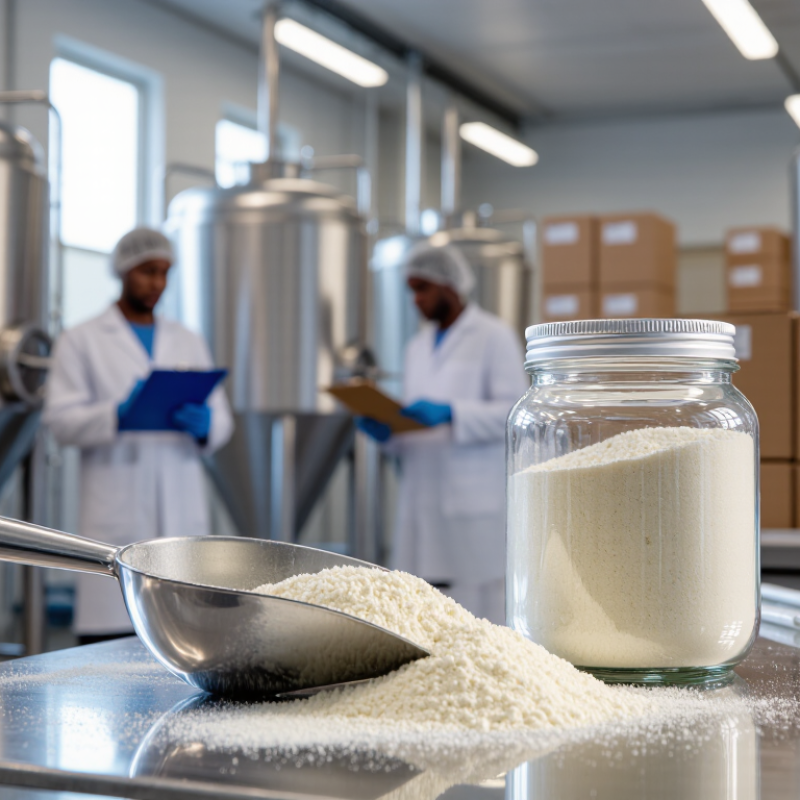
How to Find a Reliable Whey Protein Powder Manufacturer?

Define Your Whey Protein Product Requirements and Quality Standards

Define Your Whey Protein Product Requirements and Quality Standards

Before contacting a manufacturer, write a product brief that describes who will use the powder and how it should perform. Specify the protein source, target protein per serving, flavor, sweetness, texture, and intended serving size. Decide whether you need an unflavored option or a product that mixes smoothly in cold water.

Be precise. “Good taste” is not a testable requirement.

Set quality criteria that can be checked in samples and production records. Ask for current specifications, ingredient traceability, allergen controls, and testing procedures for protein content, microbiological quality, and relevant contaminants.

Agree on acceptable ranges, sampling methods, and how results will be documented. A certificate alone may not answer every question, so clarify which tests are performed by an independent laboratory and how often.

Details matter.

Request a pilot sample made to the same formula and process proposed for full production. Check how it dissolves after stirring, whether the flavor changes over time, and whether the label information matches the specification.

Keep notes, even about small issues like foam or a dusty aftertaste. I used to treat texture as a minor preference; in practice, it can affect whether customers finish a serving. That assumption deserves review.

Record revisions in writing, then confirm that the manufacturer can reproduce the approved sample consistently.

Verify the Manufacturer’s Certifications, Facilities, and Production Capacity

A reliable whey protein powder manufacturer should prove its systems, not just display certificates. Ask for current certificates covering the actual production site, product scope, and expiry date. Verify them with the issuing body. ISO’s Survey of Certifications tracks management-system certificates across more than 190 economies, but an ISO certificate alone does not confirm that a specific whey product meets your quality requirements. Request recent independent test reports for protein content, microbiological quality, heavy metals, and allergens.

Walk the facility, in person or by live video. Look for clean, controlled powder-handling areas, documented batch records, calibrated scales, and clear separation of raw materials from finished goods. Ask how the manufacturer traces a lot from incoming milk-derived ingredients to a packed batch, and how quickly it can provide records. Discuss production capacity in practical terms: minimum order quantity, monthly output, lead time, backup equipment, and what happens during peak demand. A large stated capacity means little without evidence of recent, comparable production runs.

Tips: Request a sample certificate and a redacted batch record before signing. Check that the laboratory report names the tested product and lot. Small detail, big signal. Do not rely only on a polished tour or sales presentation; paperwork can look convincing while leaving gaps. I would also ask for a written explanation of any recent audit findings and corrective actions. If answers feel vague, pause and verify.

How to Find a Reliable Whey Protein Powder Manufacturer? — Verify the Manufacturer’s Certifications, Facilities, and Production Capacity

Evaluation Area What to Verify Useful Evidence to Request Why It Matters
Food safety certification Check whether the facility holds a current certification recognized by the Global Food Safety Initiative (GFSI), such as FSSC 22000, BRCGS Food Safety, or SQF. A current certificate showing the legal site address, certified activities, scope, issuing body, and expiration date. Confirm its validity with the certification body or its official directory. Certification can demonstrate that a facility’s food safety management system has been independently assessed. The certificate’s scope and site must match the work being offered.
Applicable regulatory requirements Determine which regulations apply in the intended market and to the product’s regulatory classification. For example, U.S. dietary supplement manufacturers are subject to applicable dietary supplement current good manufacturing practice requirements under 21 CFR Part 111. Written confirmation of the applicable requirements, relevant inspection or audit records where available, and procedures for handling complaints, deviations, and recalls. Regulatory obligations vary by country and by whether a product is marketed as a food, dietary supplement, or another category. A certificate alone does not replace legal compliance.
Certificate scope and authenticity Match each certificate to the actual manufacturing location and activities, such as blending, processing, packing, or storage. Certificate number, site address, scope statement, validity dates, and a verification result from the issuer or an official certification directory. A certificate may cover only certain activities or locations; it should not be assumed to cover every product, process, or affiliated facility.
Facility hygiene and allergen controls Review cleaning, sanitation, pest control, personnel hygiene, and controls for milk allergens and any other allergens handled on site. Facility audit findings, sanitation procedures, allergen risk assessment, cleaning validation or verification records, and the site’s cross-contact control plan. Whey is milk-derived. Effective allergen controls and accurate labeling help manage cross-contact risks and support appropriate product information.
Raw material traceability Ask how whey ingredients are approved, identified, tested, and traced from receipt through finished-product shipment. Supplier approval criteria, ingredient specifications, lot records, certificates of analysis, and an example of a documented traceability or mock-recall exercise. Traceability helps a manufacturer identify affected lots and investigate quality or safety concerns efficiently.
Finished-product testing Confirm that testing is based on product risks and specifications, and clarify which tests are performed in-house versus by qualified external laboratories. A representative certificate of analysis, test methods, acceptance criteria, laboratory details, and results for relevant identity, composition, microbiological, or contaminant checks. Testing can help verify that a batch meets agreed specifications. A certificate of analysis should be reviewed for the specific product and lot, not treated as a universal guarantee.
Production equipment and process Verify that the site has equipment and controlled procedures suitable for the requested powder, batch size, packaging format, and any specified processing steps. A process flow, equipment overview, batch-record example, in-process control points, and a description of changeover and line-clearance procedures. Process controls and suitable equipment support consistent production and reduce the risk of mix-ups or avoidable variation between batches.
Production capacity and lead time Compare the requested order volume with demonstrated capacity, available production slots, minimum order quantities, and typical lead times. Capacity figures by relevant line or process, a recent production schedule with confidential information removed, planned maintenance arrangements, and written lead-time assumptions. Capacity claims should be specific to the product and packaging format. Installed capacity may differ from available capacity because of scheduling, maintenance, or other orders.
Quality management and change control Check how the manufacturer handles deviations, corrective and preventive actions, formula or supplier changes, and customer approval requirements. Documented change-control and corrective-action procedures, sample deviation records, and an explanation of how customers are notified of material changes. Documented controls help ensure that changes affecting ingredients, processing, specifications, or labeling are assessed and communicated.
Audit access and ongoing oversight Ask whether the facility permits a qualified customer audit or provides an appropriate recent third-party audit summary, subject to confidentiality and site rules. Audit scope and date, auditor or certification-body details, corrective-action status, and a process for addressing unresolved findings. Certificates provide a useful starting point, while audit findings and follow-up can offer additional insight into how the system operates in practice.

Evaluate Raw Material Sources, Formulation Expertise, and Testing Procedures

A reliable whey protein powder manufacturer should trace each lot back to its dairy source. Ask for supplier qualification records, origin details, and lot-specific certificates of analysis. FAO’s Statistical Yearbook 2024 reports that global milk production exceeded 900 million tonnes in 2022. That scale makes traceability essential: a large supply pool does not guarantee consistent protein quality. Check how the manufacturer handles seasonal changes in milk composition and whether incoming whey is tested before processing.

Formulation expertise shows in the details. Ask how the team manages protein concentration, solubility, flavor, and mixability across batches. Request specifications for protein content, moisture, and any added ingredients, then compare them with the finished-product test results. A good sample can still hide production variation. Ask for records from multiple lots, not just one polished sample.

Testing should cover identity, protein content, microbiological quality, and relevant contaminants. Request the methods used, the laboratory’s qualifications, and dated results tied to specific lots. AOAC International publishes validated analytical methods used in food testing; ask which methods support the reported measurements. Read the numbers, not only the certificate. A document may look reassuring while leaving sampling frequency unclear. If answers are vague, pause and ask for evidence in writing.

Compare Manufacturing Costs, Minimum Orders, Lead Times, and Contract Terms

How to Find a Reliable Whey Protein Powder Manufacturer?

Manufacturing cost is more than the price per kilogram. Ask for a written breakdown covering raw materials, blending, testing, packaging, labeling, and shipping preparation. A low quote may exclude several charges. Compare identical protein percentages, flavors, pack sizes, and quality requirements. Request recent batch samples and certificates of analysis before judging value. A factory with documented testing procedures is easier to evaluate than one offering only attractive prices.

Minimum order quantities can affect cash flow and product freshness. Ask whether the MOQ applies to each flavor, package size, or total production run. Smaller trial orders may cost more per unit, but they reduce the risk of unused inventory. Lead times should include formula approval, artwork checks, ingredient purchasing, production, laboratory release, and dispatch. Get each stage in writing. Delays often begin with unclear packaging approvals.

Contract terms deserve careful attention. Confirm payment milestones, accepted tolerances, rejected-batch procedures, replacement responsibilities, confidentiality, and ownership of custom formulas. Include a change-control process for ingredients, suppliers, or packaging materials. Also ask how the manufacturer handles production records and retained samples. A practical weakness is assuming every promise will appear in the contract. It will not. Review the document with a qualified advisor, especially when supplying several markets. A reliable partner should answer detailed questions without pressure. That response is useful evidence.

Confirm Packaging, Regulatory Compliance, Samples, and Ongoing Support

How to Find a Reliable Whey Protein Powder Manufacturer?

Confirm Packaging, Regulatory Compliance, Samples, and Ongoing Support

A reliable manufacturer should explain how its packaging protects whey protein during transport and storage. Ask for details about moisture barriers, seal strength, lot codes, and tamper evidence. A strong package keeps powder dry, traceable, and easy to inspect. Small details matter.

Request current certificates, product specifications, allergen controls, and batch test reports. Depending on your target market, the facility may need recognized food safety systems, good manufacturing practices, and compliant labeling procedures. Verify that testing covers protein content, microbiological safety, heavy metals, and contaminants relevant to the product. Do not accept vague claims. Ask who performed each test and when.

Samples reveal more than a sales presentation. Check flavor, texture, solubility, color, and packaging condition after delivery. Test samples under realistic storage conditions, not only on the first day. A sample can look excellent and still expose process weaknesses later. I have learned that one test is rarely enough. Request a pilot batch before approving larger production, then compare its results with the original sample.

Ongoing support also deserves a written process. Confirm response times, documentation updates, complaint handling, and corrective actions. Ask how the manufacturer manages formula changes or supply disruptions. Good support feels practical, not merely friendly. It should help you protect quality across every shipment.

How to Find a Reliable Whey Protein Powder Manufacturer?

Use these reference values when reviewing product samples and protein-label claims. The adult RDA is 0.8 grams per kilogram of body weight; the FDA Daily Value for protein is 50 grams. These are nutrition benchmarks, not manufacturer quality standards. Request product-specific test reports and confirm that packaging and labeling meet the rules in your target market.

Sources: National Academies’ adult protein RDA (0.8 g/kg/day); U.S. FDA Nutrition Facts Daily Value for protein (50 g).

FAQS

How can I verify the whey protein’s raw material source?

Ask for the dairy source, supplier records, origin details, and lot-specific certificates. Each lot should be traceable. Check whether incoming whey is tested before processing. Seasonal milk changes may affect protein quality, so ask how they manage them.

What formulation details should a reliable manufacturer provide?

Request specifications for protein content, moisture, solubility, flavor, and added ingredients. Compare these specifications with finished-product results from several lots. One attractive sample proves little. Batch consistency deserves closer attention.

Which tests should whey protein batches undergo?

Testing should confirm identity, protein content, microbiological quality, and relevant contaminants. Ask for dated results linked to specific lot numbers. Also request the laboratory’s qualifications and analytical methods. Certificates can look complete while sampling remains unclear.

How should I evaluate packaging quality?

Ask about moisture barriers, seal strength, lot codes, and tamper evidence. The package should keep powder dry during transport and storage. Inspect the seal, label, and powder condition after delivery. Small packaging flaws may become expensive later.

Which compliance documents should I request?

Request current product specifications, allergen controls, batch reports, and food safety documentation. Check whether labeling follows the requirements of your target market. Testing should cover protein, microbes, heavy metals, and relevant contaminants. Avoid accepting general claims without evidence.

What should I examine when receiving product samples?

Check flavor, texture, color, solubility, and package condition. Test samples after realistic storage, not only immediately after arrival. A smooth first mix can hide later problems. I would repeat the test, because one result is not enough.

Why is a pilot batch useful before larger production?

A pilot batch shows whether production matches the approved sample. Compare its test results, mixing behavior, flavor, and packaging condition. Store part of it under normal conditions. The comparison may reveal variation that a presentation hides.

What ongoing support should the manufacturer provide?

Confirm response times, document updates, complaint handling, and corrective-action procedures. Ask how formula changes and supply disruptions are managed. Helpful support should protect quality across shipments. Friendly replies are not enough. Written processes matter.

Conclusion

Finding a reliable whey protein powder manufacturer begins with clearly defining your product requirements, including protein content, flavor, texture, ingredients, target market, and quality standards. During the selection process, verify the manufacturer’s certifications, facility conditions, equipment, hygiene controls, and production capacity to ensure consistent and scalable output. It is also important to review the sources and quality of raw materials, the manufacturer’s formulation expertise, and its procedures for ingredient, microbiological, and finished-product testing.

Before signing an agreement, compare manufacturing costs, minimum order quantities, lead times, payment conditions, and contract terms. Confirm that the supplier can provide suitable packaging, accurate labeling, regulatory documentation, product samples, and reliable quality records. Clear communication and responsive ongoing support are equally valuable, especially when adjustments or new product development are needed. A careful evaluation of these factors can help you choose a dependable partner for Whey Protein Powder Manufacturing and build a stable, long-term supply relationship.

Vivienne

Vivienne

Vivienne is a highly experienced marketing professional dedicated to helping businesses understand innovative products, practical solutions, and evolving market opportunities. With a strong combination of strategic insight, industry knowledge, and clear communication skills, she plays an important......